Monday, 27 June 2011

Holiday: Hunstanton and Heacham

norfolk etc 111

We stayed in a road called 'The Drift', in Heacham. This is a former fishing village, now minor beach resort, on the north coast of Norfolk, looking over the Wash. In the 1790s Norfolk (soon to be supplanted by Lancashire as Britain's industrial area) was a hotbed of Jacobinism. The'Heacham Declaration' announced the formation of an early, universal trade union, swiftly suppressed under the sedition act. Today it is a small village (Victorian and earlier) bookended by, at one side a series of bungalows, and at another, towards the beach, caravan parks. Both are a kind of quotidian minimal architecture, bereft of ornament, but somehow unobtrusive in their modernity. The most impressive minimal architecture in Heacham is the Pillboxes.

norfolk etc 109

They look over the North Beach, in case the Nazis attack via The Wash. What two men in bunkers could have done against the Wehrmacht is a moot point.

norfolk etc 165

Three miles from Heacham is Hunstanton, a proper seaside resort, with Penny Arcades, shops called things like 'Geezer's Palace', amusements including arcade games of the mid-80s (Track and Field!), and so forth. Like all seaside towns it has gone to seed in an interesting way. At the seafront are curved concrete walls to prevent floods. Also like all seaside towns, concrete and Modernism are quietly, blithely acceptable, perhaps because the purpose is hedonism, however circumscribed, rather than English home-making.

norfolk etc 162

The most famous thing about Hunstanton, although it doesn't feature on the postcards, is a much less blithe kind of Modernism: the Hunstanton Secondary Modern School. Designed by Alison and Peter Smithson in 1949, while they were (remarkably) in their early 20s, it is as far from seaside jollity and all its cheerful crapness as could possibly be imagined.

norfolk etc 117

Practically anyone interested in 20th century architecture will have seen it in photographs, the water tower at the entrance and the severe geometries. 'The first New Brutalist Building', 'the most truly modern building in Britain'. This gives you absolutely no hint of just how wildly incongruous it is with the surrounding area. In amongst the bungalows and such, this sleek, ruthless object. The Smithsons spoke of the building having two lives - one as a noisy comprehensive school, 'and another life when the building is empty, a life of pure space'. Me and my sister go there on a Sunday. The gates are open, so we get the life of pure space. The 'found objects' element you always see in photos is the metal water tower, not the even stranger, even starker brick tower behind it.

norfolk etc 120

Yet it's just a secondary school. Its fame worldwide seems to accord with its obscurity in Norfolk. A perfect example of Welfare State ethics in its most extraordinary form - a sublime object dropped, seemingly at random, landing in the midst of an unremarkable English everyday. Now, of course, rather than being truly comprehensive it 'specialises' in Maths and Computing, in that offensive Blairite manner - something that polymaths like the Smithsons, enthusiasts for art, pop, science, philosophy, would undoubtedly have been depressed by - but Secondary Modern will always be the phrase associated with it, with the latter of the two words stressed.

norfolk etc 126

The length of the main block is almost a shock, the deliberate aestheticism and imposition. Without ever using the raw concrete that Brutalism would be known for, it creates the sense of power and force, the memorable image, that the style brought to Modernism. Even the additions, the black panels on the main block's windows (to stop the sea winds smashing them) seem to reinforce the buildings' domineering effect. All this at one storey high, with De Stijl colours and stock brick - pointedly not the local stone and ragged brickwork which features in so many buildings in the area, which itself seems a Dutch importation, has something rather continental about it.

norfolk etc 116

At the back are fields which seem to go on forever. The endless Norfolk flatlands, with barely a hill all the way to the Urals.

Originally posted at SDMYABT on 06/09/08

Urban Trawl: Croydon


The suburbs are back, this we know. Ever since Boris Johnson's 'Zone 5 Strategy' reminded everyone how successful a politician can be by appealing to the Free Born Englishman's age-old right to drive at 4 miles an hour rather than taking a bus, the Party of government has explicitly favoured suburban, south-east England, especially as the North becomes even more hostile to it. Croydon may be a typical slice of the London/Surrey grey area that has been a conservative bastion for over a century. Why is it, then, that the first impression a stranger might have of the centre is of a large, dense, multicultural, independent provincial city? Why does the London Borough of Croydon so much want to be a City itself? And what can we learn about what a 'suburb' really is from this place?


If it ever gets its long-stated wish of becoming officially 'urban', this quintessential commuter suburb will become a city of above average size, roughly the size of, say, Coventry, or Hull. It has its own rapid transport system and it's own rather particular pattern of urbanism, both of which are lacked by many official British cities. Many will be familiar with the strange sight that hits you when leaving East Croydon station – with the trams and high-rises, you could believe you were in a wealthy West German industrial city, until you walk around a little. What you find on investigation is that Croydon is in fact very English indeed, a result of the subjugation of planning to commerce. In short, what happened here in the 1960s is that an ambitious council offered businesses cheap office space if they would fund infrastructural improvements. Within an astonishingly short time, they transformed a burb into a minor metropolis of skyscrapers, underpasses and flyovers – the trams would come rather later. Since then the place has been the butt of numerous jokes. 'Mini-Manhattan', as if trying to be like New York was somehow less interesting than being like Surbiton. Croydon had, and has, ideas above its station, and for that, at least, it's hard not to warm to it. Yet the problem with the place quite quickly becomes apparent. Rather than this new metropolis being planned or coordinated, the dashing appearance from a distance gives way to a messy, chaotic reality, planned in the good old, ad hoc, throw everything in the air and see where it lands style so beloved of England.


In its ethos, the erstwhile Croydon Of The Future resembles the Enterprise Zones of the 1980s more than municipal planning, But in aesthetic, it's a 1960s living museum, because the place is remarkably intact; a mere couple of recladdings, only two completed post-1970s towers (neither of the slightest note, though Foster and Make schemes are planned). Much of what you can see is mosaic, concrete and glass in the English corporate modernist manner. Accordingly, it has an accidental uniqueness – things obliterated elsewhere survive. There's a fair amount of period charm, not much in terms of real quality. Seifert's fabulous NLA Tower, probably their best along with Centre Point and NatWest, is justifiably Mini-Manhattan's Empire State; but there's little else that shows any spark. The pleasure instead is seeing the past's generic, everyday architecture in an unusual state of completeness and survival.


So there's the once-chic, now-shabby tapering tower the council built as their own offices, which complements nicely their earlier, enjoyably debased Victorian halls; a couple of sub-Seifert cubist experiments; a jollily Festival of Britain Travelodge; Hilberseimer-style Zeilenbau blocks step along where a developer could get a big enough plot; and the chimneys of a power station ornament a giant IKEA. Residential towers are massively outnumbered, but there's three worth noting: the Lubetkinesque Cromwell Tower, some more Festival styling on Coombe Road, or the cute Zodiac House, which fans of the sitcom Peep Show will be familiar with. The best bit, comfortingly, is an enclave of public space, the mosaic-piloti and shell roof Arcade of St George's Walk, which emerges from behind the drab Nestle Tower.


The problem, or for the dedicated flâneur, the fun, is in how it interacts with the suburb all around. Or how it doesn't. Arrangements are totally random – a row of artisans' terraces with skyscrapers behind, would-be secluded Tudorbethan facing giant high-rises, the sound of birdsong accompanying an endless rumble of traffic. Sometimes the place seems to be mocking itself, as when churchyard meets concrete subway you find the sign 'OLD TOWN CONSERVATION AREA'. In fact, there's a lot of pre-Victorian, never mind pre-1960s remnants in among the towers, if you know where to find them. It adds up to one of London's more surreal urban experiences, taking the capital's pre-existing aptitude for the juxtaposition and amplifying it.


So Croydon is, at first, nothing like what a suburb is supposed to be. But look for the housing built at the same time as the new metropolis and you find that LA was the model much more than Hamburg or Chicago. Wates' Park Hill estate (no relation) is a case in point. This is one of the leafiest, lushest of suburbs, with either bland, tiny detached houses or vaguely Eric Lyons terraces in amongst mature trees giving way to, extraordinarily, three short terraces by Atelier 5, in a state of impeccable kemptness. However, this is exceptional; what is much more typical is the sprawl around the Borough's centre, those burbs where 'going into town' means going into Croydon, not the West End.


Thornton Heath, for instance, where the borough's only notable post-1970s building has just been completed, FAT's new Library extension. Drop the 'OMG jokes' reaction for a second (if we're lucky, the architects might sometime do the same), and it's a remarkably serious, not at all whimsical public building, warm, welcoming and on this Tuesday afternoon, very well used. It looks comfortable, which is an interestingly rare thing in new architecture. As a building, it's a great reproach to the rash of library closures. It takes a small-scale thing and makes it better. But this is a place with large-scale problems. And far more typical of the attempts to solve it are new spec blocks of flats, or Saunders Architects' generic Blairbuild Thornton Heath Leisure Centre. Maybe that'll survive long enough to acquire the centre's unexpected period charm, but it seems unlikely. This place has suffered from over a century of non-plan, and the result is chaos – dereliction next to newbuild, dramatically crammed and then almost criminally low-density. It's full of surprises for the walker, but it's a disastrous way to run a city, as the horrendous traffic, or the decidedly fractious tenor of public interaction, makes very clear.


But what does it say about South-East, suburban England, the area that lords it over the rest of the country? This place is, in theory, a major centre of our most powerful, most wealthy, most leafy area. You'd never guess, though, as it feels like another Britain entirely - a poor but multiracial, intriguing but miserable place which could really do with social planning and social housing, rather than more speculation and a BID. Croydon is not smug; unlike neighbours such as Carshalton, it won't be going all creeping Jesus Big Society anytime soon. It's a place. It could be much more so.

Monday, 23 May 2011

Urban Trawl: Brighton and Hove


It could be said, and it would be only slightly hyperbolic, that we are all Brightonians now – or at least, our governments and local councils would really rather we were. The seaside city of Brighton & Hove is a place with a radically immaterial economy of tourism, property, media and 'creativity', a city of leisure. Unlike, say, Richard Florida's other favourite British city, Manchester, it has no industrial past to uncomfortably erase; but like the cities that would desperately like to emulate it, it has a large and ignored working class population, often living in large and slightly-less-easily ignored tower blocks. Brighton and Hove were built for fashionable London on holiday, and so it remains, at least after a 'decline' when it became more proletarian. In short, there's a lot to get annoyed by. The problem, however, with maintaining a critique of the place is that it is – especially on a sunny day – so gorgeous that it's almost impossible to keep your faculties about you. In an analogous but visually very different way to Milton Keynes, Brighton is the most seductive city of the new economy.


It's also the city which has been the first to elect a Green MP, Caroline Lucas, and right by the station is something that combines the two elements of the place – harmoniously uniting right and left Brighton, if we're being extraordinarily generous. This is the grandiosely named New England Quarter, a piece of brownfield regen, fundamentally indistinguishable from any other up and down the country. Much of it is in the anonymous, render/wood/metal balconies style, with the latter amusingly skimpy, implying some very svelte occupants; the central tower, Fielden Clegg Bradley's 'One Brighton', has a marginally clearer, more convincing presence. The difference, as ever, is in the marketing. At one corner is 'Brighton Junction – an ethical property centre'. Their italics, and their protesting too much. Ethics in the development are expressed through underground carparks hidden under Sainsbury's, Subway and the 'public realm' – and some extensive gating. 4 x 4s glower their way down the surrounding roads. Then you come to one of the city's many council tower blocks, a thin, stock brick thing with, unforgivably, an expressed, concrete car park on its ground floor. Drive, by all means, but be discreet.


From there you can walk through North Laine and Sydney Street, whose bright colours and painted shops are a centre of the city's alternative culture, with some undeniably rather intriguing shops among all the sub-Carnaby Street nostalgia, which is best signified by the prominent sign 'Madcap Items £20'. North Laine's hip-bourgeois nature has recently been accompanied by something more square-bourgeois – Bennetts' Jubilee Library, and the several blocks around it. The Library itself is quite a fine building, especially for a PFI and Design & Build contract. Its elegance is almost entirely down to neat proportions and the decision to clad much of it in deep blue glazed tiles, a subtle nod to one of the city's Victorian materials, which fits the general raffishness very nicely. Somewhat less successful is the obligatory thwacking great atrium, which is visible on the façade via a blue glass expanse soiled by the city's anti-social seagulls. The blocks around, housing the usual middle class chains – Wagamama, etc – are inoffensive, if bland, so it's the offsetting that offends – the notion that a library must be justified by lots of surrounding retail. As ever, the entrance to Pizza Express is far more visible than that of the Library itself.


Fashionable Brighton is not nearly as interesting as it thinks it is. In fact, the element of the city that really convinces, that saves it from completely irredeemable smugness, is the tourists' seafront promenade. One route takes you past irksome retail old (the Lanes, where it is acceptable to call a shop 'Pretty Eccentric') and new (CZWG's Black Lion Street, actually a rather imaginative bit of infill which nonetheless houses a Jamie Oliver restaurant). Then you get to this thing, somewhere between a Regency utopia and a Brutalist Miami, defined most magnificently by a feeling of space and air without parallel in the UK, with a wide, wide boulevard, spacious streets and lawns, and the Channel spread out before you. It's glorious, and that glory is given particular pathos by the ruins of the West Pier, a haunting reminder of the city's persistent hint of the sinister.


Giant towers are planned and seemingly shelved at each end – a monster hotel by Wilkinson Eyre to the east, an observation tower by Marks Barfield to the east. Frank Gehry's plans for Hove, meanwhile, seem not so much shelved as permanently cancelled, although that's no great tragedy, as they bore about as much relation to his best work as Gropius' Park Lane Playboy Club did to the Dessau Bauhaus. As it is, modernism is represented by some still controversial structures. One scheme which is surely due some critical rehabilitation is the Brighton Centre and the accompanying Odeon designed by Russell Diplock Associates. Both sit at the point where Brutalism and futurist kitsch meet, and are all the better for it, with the Odeon's expressionistic roofline a particular thrill. Even more hated by custodians of Brighton are the several Seifert schemes that crowd behind Waterhouse's aggressively red, late Victorian Hotel Metropole and the fussy, part-bombed Grand. There is one unforgivable element to them, where Seifert saws off Waterhouse's skyline, replacing it in the clumsiest, lamest manner possible – but the irregular grids of the Seifert towers are very smart, both up close and from a distance, adding a metropolitan skyline drama which, along with the council high-rises, stops the townscape from becoming a mildly more seedy seaside version of Bath.


The other major modernist scheme creates a demarcation between Brighton and Hove, both in terms of scale and style, but it's of far from local significance. Wells Coates' 1936 Embassy Court, recently and thoroughly restored, follows on the ideas of his experimental Isokon housing in London, employing its ideas on a massive scale. It might have been built as serviced flats for light entertainers, but it's clear here how much Coates was indebted to Constructivism, especially Moisei Ginzburg's Narkomfin building. The seaside front is clean and classic, but lurk round the corner and the building's circulation is on spectacular display, with strongly, bulgingly modelled access decks and staircases, so lush and physical that you feel you could eat them – it supports Manfredo Tafuri's one-time description of Coates as a 'proto-brutalist'. It's one of the most remarkable blocks of flats in the country, but there's several of its era in Hove.


But first you pass through Brunswick Town, which is as complete an expression of Regency luxury aesthetics as Embassy Court is of the '30s (or is it the other way round?), with its often breathtaking Crescents and squares. Looking at the way the bow-windowed terraces sweep down the hills to the sea, you sense that here there was a real seriousness about high-design, high-density living combining with hierarchy, profit-making and speculation. It's the Urban Renaissance of it's day, except immeasurably more confident and proud in architectonic execution. Go up the hill a bit from here, and you find much more. If Bethnal Green is a museum of working class housing, Hove is a museum of the luxury flat. Every permutation is on show. The clipped, Jeeves & Wooster neo-Georgian of Wick Hall, now a Buddhist Centre ('Meditate in Brighton', it suggests - a new, more pious approach to self-help); the Crittall Windows and wave motifs of Furze Court, with additional Bupa centre; Eric Lyons' typically elegant Span Development at Park Gate; or St Anne's Court and Beresford Court, outré combinations of traditionalism and 30s' metropolitan display. The former has a blue plaque informing us that Lord Alfred Douglas once lived here. As well he might.


Interestingly, and sadly, the newer blocks of flats do exactly the same thing, on exactly the same low-to-mid-rise scale, for exactly the same kind of clientèle – Hove's sleepy and/or elderly, and ex-Londoners – but are so dramatically clumsy and poorly made by comparison. There's Landsdowne Court, with blocky red terracotta cladding and strikingly lumpen, cheap-looking balconies – it could be in any number of less favoured, less wealthy towns. The blocks next to Beresford Court are especially alarming – here, perhaps as some consequence of the winds coming in off the sea, the wood panelling has deteriorated so rapidly that it looks burnt. Or in fact, it looks like the boarding councils use to deter squatting. It's all indicative of one of the stranger things for which the last 30 years can be indicted – that often, even the luxury housing was poor. It seems to sum up a few truths about this attractive but impressively hypocritical city. But at least from here, you can walk down to the seafront, take in those winds and that space, and pretend that everything's going to be alright.

Tuesday, 19 April 2011

Urban Trawl: Bristol


Bristol is perhaps the one southern city which really feels independent of London. For whatever reason – its diversity, its distance, or the internal emigration patterns of wealthy Londoners in the 1970s, some might suggest darkly – it largely lacks the lamentable parochial mentality and substandard architecture so common in the Lutons, Portsmouths, Readings, Southamptons, Guildfords and Swindons. It's clearly a very long time (200 years to be precise) since it was the UK's Second City, and the port is now six miles away from the centre, but it doesn't feel all that bothered by either fact. Bristol doesn't feel all that bothered by anything, which is its virtue but also its curse – it takes itself both too seriously (as centre of alternative culture, street art and suchlike) and not seriously enough (as modern, industrial city and sponsor of architecture). Stereotype it may be, but the place is seriously lackadaisical, and it succeeds and fails on this. Often, architecturally, this big, dynamic and multi-racial city feels like it's been asleep since 1910; the awakenings, when they happen, can be like nightmares.


As an example of the wastes that Bristol's general air of torpor can so easily create, there is little better than the area around Temple Meads station, one of the worst introductions to the city in the UK (and here, happily, a deceptive one). Inside, a Brunel shed and then immediately outside, cutely silly Jacobethan – but then, in front of that, a wasteland, made up of some startlingly grim 1960s buildings (to paraphrase Ian Nairn, if you want to like modern architecture, don't come to Bristol) wide and pedestrian-hostile arterial roads, and in the middle of it all, looking forlorn, the moderne Grosvenor Hotel, as featured in Chris Petit's classic film Radio On. In that film, the Hotel was passed by a spindly steel flyover; that went in the 1990s, but though less modern and hence apparently less 'alienating', the road is surely even more obnoxious and impassable without it. Then opposite that, we have one of the finest, most original Gothic buildings in the UK, in the craggy, lurid form of St Mary Redcliffe, all monsters, tendons and grottoes. It has no foil, is not placed into a viable public space. It just sits there surrounded by traffic.


Go past this towards the river and the centre, and things pick up very quickly; past the tiresome radical chic ('Che's Bar') is the frankly staggering 1869 Granary, a monumental example of the misnamed 'Bristol Byzantine' style, all Venetian detail and hulking robustness - this is real port architecture, worthy of a Glasgow or a Hamburg, and you can smell the sea. Bristol architecture could have developed from this style, or from its unique Gothic heritage, into some form of Amsterdam School Expressionism. Yet the Georgian tradition is equally present here, so in the 20th century neo-Georgian, like the bloodless Council House that insults the Cathedral, was a safer bet. Topograpically, the Granary gives way to the huge showpiece of Queen Square, where elegance, pastiche and muddle are made coherent by the simple 18th century plan. Amazingly, in the 1930s a road was built bisecting the square, and the 1990s removal of that, at least, was probably mourned by few.


Anyone looking just for good buildings can easily find an enormous amount to admire in Bristol – late Medieval, Regency and early industrial architecture is especially rich here, though there's little Victorian or modern work of comparable note. As townscape, the city is all over the place. The dramatic topography and tight, winding streets seem to encourage this, so the city's most interesting places are all a matter of hills, snickets and unexpected, panoramic vistas. Often, however, you'll step out of the bustle into a void. Conventional wisdom may bunch them together, but Bristol's post-Blitz rebuilding was more Sotonian fudge than Coventrian triumph. There are exceptions – near the University there is a tiny, clipped Barclays Bank that is quite exquisite – but the stumps of several clearly uncompleted schemes lie scattered all over the place, from the Stafford Cripps Beaux Arts of Broadmead to the roundabout expanse of St James Barton. The former's architecture as bland as the latter's planning is inept.


Perhaps the most successful of these measures is, aptly enough, a shopping mall – Chapman Taylor's partly open-air Cabot Circus, which, tastelessness aside, is a spatially imaginative thing, all flying walkways and quasi-parametric roofs. Like Liverpool One, the clone-town tenants somewhat defeat the object of designing a Mall as a real piece of city. While there I'm told that Cabot Circus is in effect a long-delayed element of the 1940s City Plan. In a city where the Gothic Revival lasted until the 1920s (in the form of the enjoyable pastiche of the Willis building), it somehow makes sense. But it's not all slumber; Charles Holden's earliest buildings are here, a Library and (mutilated) Hospital of striking civic confidence and originality, albeit with few successors here.


The other redeveloped area is the city docks, which closed to industry as late as 1991. Mostly, Bristol can be criticised for not hiring architects of any talent or significance; here that doesn't apply, and yet the results are just as unimpressive. Fielden Clegg Bradley's housing is identikit city-centre-living well below their usual standard, Hopkins' '@Bristol' entertainment centre is muddled and drab, and Cullinan's housing scheme in particular is distressingly poor, with no trace of their usual originality and drama, indistinguishable from the work of the usual regen grunts. And that, 80s neoclassicism and the obligatory 'iconic' bridge aside, is basically that for new architecture. If you must, then further back into the centre there's the tacky post-war reclad of the Radisson Hotel, and sundry CABEist blocks scattered around around at random. Most are furnished with the usual phoenix-from-the-ruins public art.


That might not be the essence of Bristol's urban identity anyway – who needs architecture when you've got street art? Here I should declare my prejudice in advance – I don't find Banksy funny, nor particularly 'subversive'. Yet his redecorations of Bristol façades at least have a point to make of some description, however obvious. Mostly, areas like Stokes Croft are daubed in day-glo inanities of various sorts, as relentlessly bright and jolly as a bumptious barcode façade, though with more countercultural pretensions. Meanwhile, above Stokes Croft are the impressive interlinked towers of Dove Steet Flats; regardless of the planning hashes, Bristol's City Architects evidently had at least some talent. As a resident walks in, we mutter of these hilltop beauties 'the views must be amazing'. 'They are', he replies. 'But they're so bloody cold that I'm actually warmer out here than in there. I'd die to get out of 'em'.


Bristol makes a better use of its topography than any English town outside Yorkshire, and identical towers were proposed for another hilltop site near the University; they were replaced with High Kingsdown, a low-rise scheme which shuns the site's loftiness – but, happily, here the reaction against monolithic planning led to an imaginative, complex arrangement of houses rather than mere pastiche. Its Swedish politesse fits the sleepy city very well, as does its labyrinthine arrangement. Plenty of mock-Victoriana would follow, of course, in the subsequent reaction against even this tamed modernism. One Thatcher-era villa nearby features a Victorian-style roundel showing its builders as bewhiskered nineteenth century notables.


From the University's elevated point, the beauty of Bristol is inescapable – the details at ground level may often be poor, but up above it doesn't seem to matter. There's one last moment here, though, a piece of half dirigiste, half accidental 'planning' so exquisite that it could be a whole model for how to stitch together the contemporary city.


Bristolians may be alarmed to find that I am referring to Lewins Mead, a 60s-70s redevelopment of a medieval area with walkways and towers. It is, the two estates above excepted, the most interesting part of modern Bristol. That's not for the elevations – most of these office blocks are of little note. It's because, if you have a good enough guide, it's the city's most rewarding promenade architecturale. Start on the walkways, pass through towers, survey the views of the city's innards, then proceed along alleyways, past fragments of the old city walls, slip through doorways, and spot on the way art nouveau printworks, expressionist adornments on contemporary nightclubs. Here, just for once, this perpetually unfinished city makes a virtue out of its heterogeneity, with the walkways and alleys providing surprising and thrilling pieces of townscape. Somehow it has all bled together into one, a delicious melange of faïence, concrete and Bath stone. It's a great improvisation, and it exists outside of all our familiar divides – masterplanning vs localism, Ville Radieuse vs Rue Corridor, it doesn't matter. Given how much of the UK is this diverse, this messy, there's a lesson here or several. For Bristol to take advantage of this chaotic dynamism, it might have to take its architecture seriously.

Originally published in Building Design, 17th March 2011

Tuesday, 5 April 2011

Pimlico Parade


(this essay is a reflection on/explanation of a walk as part of Critical Practice's 'Parade' event at the parade ground of the former barracks opposite Tate Britain, on an extraordinarily hot day in summer 2010 - it entailed a long walk around the area, so what was at first a decent crowd ended up as me, Pyzik and two exceptionally loyal walkers. It was of course written before the events at Millbank Tower last year, although some of these photographs were taken afterwards)

There was never really any question about where to parade in Pimlico, and that was out of the former Parade Ground, not to mention out of the sweltering heat that the crate-construction could never quite provide shade from; so our stall advertised a walk, first one hour after the start of the Parade, then two hours, as we attempted to convince at least some visitors to come along. The idea was a Tour Around Socialist Pimlico, where we would try to find the hidden socialist potential of these deeply overdetermined streets. The area around here, where Pimlico adjoins the back end of Westminster, is one of the last great London secrets, a haven of experimental and socialistic housing in the seemingly deeply unsympathetic shadow of the Houses of Parliament's tortured crockets, or under the glass contours of the Millbank Tower used alternately as campaign offices by New Labour and Cameron's New Tories.


The phrase which always comes to mind here is 'hiding in plain sight'. Though we're the shortest of walks from some of the biggest tourist traps in the world, it's quiet, mixed, strange, at times poor, though never the kind of traumatic poverty you can find elsewhere in London. This sort of contrast is supposed to be what London is 'all about', but elsewhere it has become increasingly grotesque, as council estates give over their open space for the construction of 'aspirational' towers for incomers, as the most painful poverty and the grossest wealth live next door to each other. There are huge contrasts of wealth here too, but never on the same horrifying scale as a Clapham or a Hackney.


So, where are we exactly? The City of Westminster is not habitually considered a residential area, but for most of the 18th and 19th century it was a fearful slum, and at the sort of proximity to Parliament that would make it the ideal assembly point for an insurrection. The 'Improvement' began in the late 19th century through the Peabody Trust, the charitable body which built tenements for the 'deserving poor' all over London, and still does. Some of their cliffs of yellow stock-brick flats still stand here, still partly social housing next to some of the world's most expensive property. From here until the 1970s, the area would become the centre for some London's strangest and most overlooked council estates. It would briefly return to prominence in the 1980s, when Westminster City Council was under the control of an enthusiastically Thatcherite group around the Tesco heiress Dame Shirley Porter.


Although it had always been a Conservative council, Westminster was a marginal, at the constant risk of falling to Labour. Porter decided the easiest way to keep control was to expel the Labour voters, which she did, by forcibly moving tenants from safe and well-maintained properties in Pimlico and the centre of Westminster, to asbestos-ridden blocks in Paddington, sometimes out of the borough altogether to encampments in Barking, and sometimes onto the streets. Soon after this gerrymandering was discovered, Porter left the country, and is still essentially a fugitive from justice, yet her approach would be extremely influential on later Conservative and New Labour policy, where wholesale transfers of council tenants from inner to outer boroughs would accompany the selling off of council housing. Porter called her gerrymandering Building Stable Communities; Labour called it Building Sustainable Communities. And it worked – Westminster is now a safe Tory seat. Yet perhaps her most amusing, and perhaps Pyrrhic, defeat was at the hands of the Duke of Westminster, owner of the Grosvenor Estate, which his ancestors had given over to 'the housing of the working classes' in perpetuity. He took Porter to court, and her defence was to claim that the working classes no longer existed. She lost, with the peculiar side-effect that the existence of the English proletariat was proven in court by the Duke of Westminster, Britain's richest man.


Walking around the place now, Porter can be seen to have won an only partial victory. There is some deeply horrible infill, in the bumptious, shoulder-padded style of the 1980s, but there are still many corner shops, greasy spoon cafeterias, community centres – often the places lacking from the gentrified but apparently more 'edgy' streets of Hackney.


This was especially obvious on our walk, as part of the small group were two locals, an elderly couple, one in a wheelchair. We started at the London County Council's Millbank Estate, exactly at the back of the Parade Ground. Designed in the 1890s, this was the second council estate in London, after the very similar Boundary Estate in Shoreditch. While the charity-driven Peabody blocks near Parliament are social housing on sufferance, deliberately grim and imposing, sanitary but unfriendly, the blocks built by local government were, with equal deliberateness, humane, lined by trees, and finely architecturally detailed in a muscular style, with a park at the centre. The contrast is an object lesson in the idiocies of the 'Big Society', with its fetish for charity and its denigration of 'the state'. Aptly, as the LCC estate shows the explicit influence of the Socialist idealism of the Arts & Crafts movement at its best - William Morris' News from Nowhere partially built round the corner from the Parliament he re-imagined as a stables. Aptly, in the hinterland of the Tate Gallery, the blocks are named after painters, and this being Victoriana, the remembered – Millais, Ruskin – are mixed with kitchmeisters like Lord Leighton.


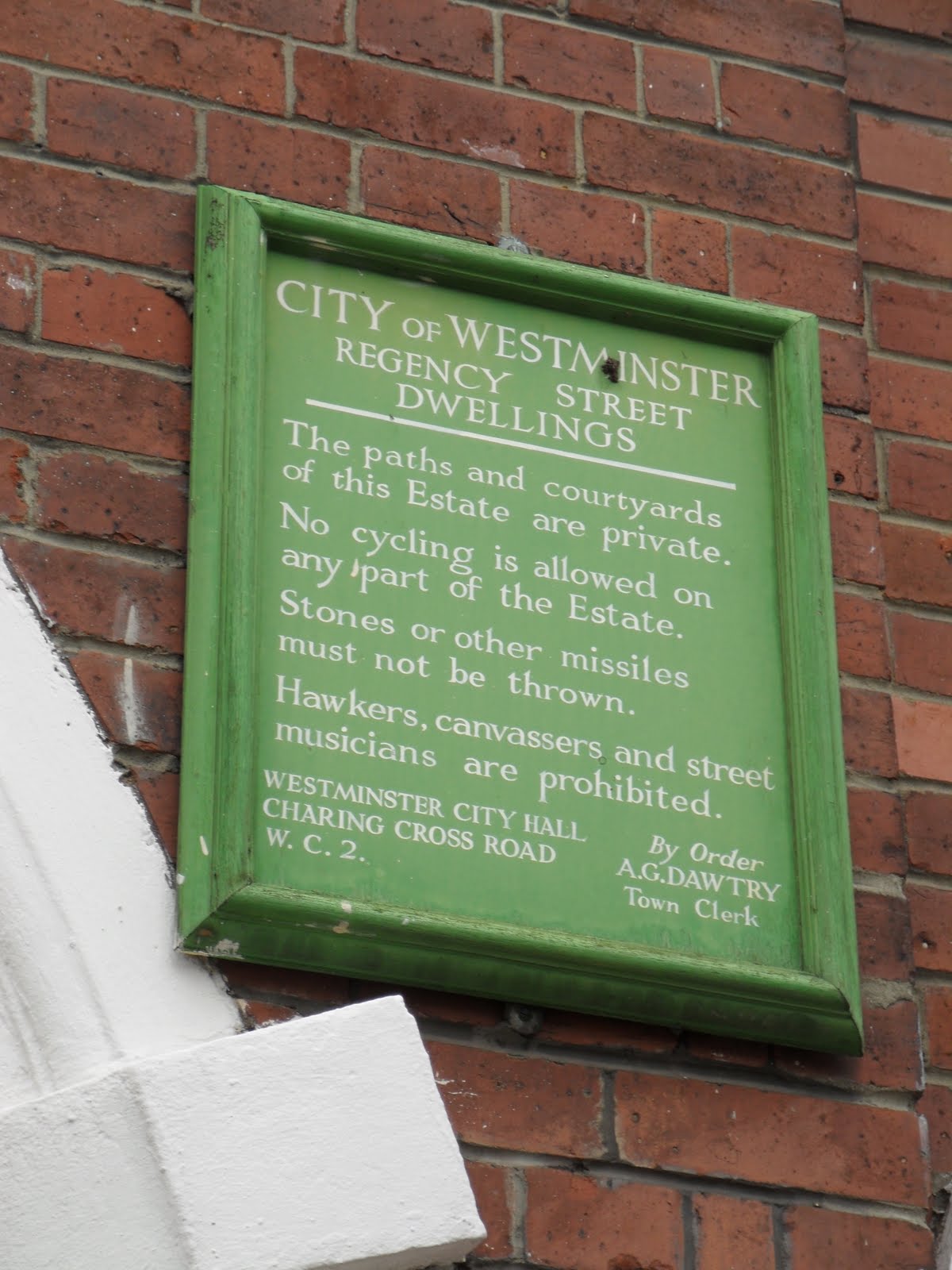
A convoluted walk from there takes through more of Peabody's tenements and terraces, and past the Hide Tower, a tall, clipped and minimal concrete tower block that strangely remains unobtrusive, hence, presumably, the name. Our destination is the Grosvenor Estate, another, later London County Council development, this time of the late 20s. The designer was Edwin Lutyens, the neoclassical architect of New Delhi and much of interwar London – this was a very rare use of outside architects by the LCC. The prosaic description does it no justice – this is a space right out of Kafka, or rather Lewis Carroll – a series of square blocks of flats with checkerboard patterns on the outside and long, white access balconies on the inside, with the rendered concrete resembling some kind of icing, the patterns like Battenburg Cake. From Regency Street or Page Street they create one of the strangest urban landscapes in London, an outright English Surrealism that was one of that decade's few real equivalents to (but not imitations of) continental Modernism. The blocks enclose communal gardens, and smaller neo-Georgian pavilions, which house hairdressers, a corner shop, a 'Multi-Cultural Centre'. There's particular justice in the aristocrat's victory over the Tesco Council leader here, in that an area like this would be gold dust to the property speculators, if they ever got hold of it, but here it appears to be entirely functional council housing. I'd read in a book on Porter that these flats were originally built without inside toilets, but am firmly corrected by the two locals. 'My grandparents lived here, and they definitely had loos'. From here, we walk to the red-brick Edwardian Regency Estate on the other end of Page Street – similar in scale to the LCC Millbank Estate, but with the original arts & crafts touches replaced with a more familiar Tudorbethan. We stop here, to look at the archways that enclose the communal gardens, noting the typically stern sign warning against 'hawkers', and they decide to leave the walk, wheeling into their flats. Were it open, we would at this point have made a stop in the Regency Cafe, a moderne, black vitrolite palace of tea, but it closes early on Saturdays.


From here, we cross Vauxhall Bridge Road, noting a hoarding promising 'Homes for Key People', to Lillington Gardens, a 1960s council estate designed by Darbourne & Darke. Some of the blocks are named after theatrical and literary figures, inadvertently making this one of London's camper estates – Noel Coward House, indeed. For enthusiasts of the era of social democratic planning, Lillington Gardens is as much a peak of architectural and social achievement as the Millbank Estate round the corner, both of them lushly detailed in red brick. Here, the architects took their inspiration from the Church of St James the Less, a cranky polychrome brick monster, and the brickwork is some of the most gorgeous in London. The flats are on multiple levels, here sprouting walkways and there traversing service roads, but mostly enclosing winding pedestrian paths, lined with overgrown vegetation (the cars are there, but hidden underneath). They provide a whole self-enclosed world, a dramatic but never dominating townscape, unafraid of the sublime but not aggressively so. There's not much housing as good as this anywhere, which makes it particularly satisfying that, for a time, until the introduction of the Right to Buy council housing, it was impossible to actually purchase a flat here. It was a right, but not a property right. This is one of the few estates that few have a bad word for, yet the funny thing is that the architects designed an almost identical complex in Islington. It was stigmatised as a 'sink' and mutilated, although this may or may not be connected with the intensity of gentrification there.


The rest of Pimlico is full of the stucco'd early 19th century terraced housing designed for the Empire's more lowly clerks, which time, sentimentality and gentrification has elevated into a model for all housing to follow. Along some of these squares and rows, to Pimlico Comprehensive School, designed by the LCC's successor, the Greater London Council, the entity which was abolished by the Conservative Party as a threat to central government. It's a little concrete battleship inside a stucco square, in the same angular, dramatic style as the GLC's Hayward Gallery over the river. The School was almost completely destroyed in the late 2000s, to make way for one of the new Aspirational City Academies, in order to inculcate neoliberal ideology in Pimlico youth. But we're here for another contrast nearby.


Dolphin Square is the only place on the walk that was built as private housing – and luxury private housing at that, a monumental late 1930s complex whose current inhabitants include Prince William. We sneak in through the private archway, and notice that a bit of a party is in progress – the ruling class evidently has something to celebrate. Creeping to the other side, we arrive in Churchill Gardens. This, the largest of Pimlico's estates, was once a model for the whole country, embodying the brief socialist hope of Clement Attlee's 1945 Labour government. Although it was commissioned by a strange alliance of Conservative and Communist councillors, it was built contemporaneously with the 'three-dimensional socialist propaganda' of the LCC's Festival of Britain. It's all wide open spaces and huge, confident slabs, on an utterly heroic scale. Voices bounce and echo off the glass stairwells. At the centre is the steel tower which once housed the estate's heating system, which ran off waste from Battersea Power Station, just over the river. It sits derelict now, the baton passed between developers every couple of years - the biggest property scam in London. It's where the Conservative Party launched their 2010 election campaign, and an apt place to finish, as they intend to slash housing benefit, ensuring that inner London is only a place for those who can afford it. The estates of Pimlico, however, are still marching distance from Parliament.

An edited version of this appears in Parade: Modes of Assembly and Forms of Address.

Friday, 1 April 2011

This Way


Lots and lots up on Flickr: Southampton, Coventry, Leeds, Oxford, Barking, New Ash Green, Sheffield, and more of Manchester.

Quadrangular: Oxford


This is a post vaguely inspired by Pevsner's unfinished, recently reassembled Visual Planning and the Picturesque, where the great man wanders round Oxford, Lincoln's Inn and Roehampton's Alton Estate, seeing all of them as exemplars of an irregular, organic approach to planning based on juxtaposition and flow rather than orders and axes. It's an interesting way of planning a city, no doubt, but it has certain differences with how most of the cities I like work.


For instance, the approach from the railway station. Like Cambridge, it's based on making sure industrial modernity doesn't stray to far into the heart of the city, so your first sight of it is a car park and some Barratt/Bovis/Wimpey/whoever dreck. The cities that look exciting from the train - Sheffield, Manchester, Liverpool, Newcastle, even Newport - throw you straight into the city, all bridges, office blocks and spires. Here, the most interesting thing is this bit of rationalismo by Dixon Jones, which is weirdly more like an Aldo Rossi painting than any actual Aldo Rossi buildings I've seen.


The last time - the first time - I was in Oxford was with IT a few months ago. Naturally, as a lecturer in an ex-poly she can barely look at the place without fury. As a way of building a city, it's certainly spectacularly exclusive - around half of the spaces are basically private quadrangles open only at the colleges' discretion. This also has interesting consequences for the modern architecture of the city - as there's loads of it, it's all post-war, it's all very good, but it's nearly all hidden away where the tourists won't look. So though you might enter something like this, above...


After a little while you will come to something like this. These, the Beehives, are the first Modernist buildings in Oxford, designed in the '50s by the Architects Co-Partnership, at a time when most of the new buildings were neo-Georgian. My guide has a short text on the subjectwhich explains their appeal better than I could.


Much as the Harold Wilson-era Labour intent seemed to be the making a more mixed-class establishment by opening up education to gifted working class youth, rather than getting rid of the establishment altogether, modernism, when it belatedly arrived in Oxford, followed the rules of an inherently exclusive and undemocratic city, only attempting to give it a new and more democratic sense of space and style. So as they're fundamentally unchallenged by it, the colleges treat it very well - no spalling concrete here, in the courtyards.


The process continues after Modernism, in an even more self-conscious fashion, as Arup's prickly brutalist quadrangles give way to the early '90s postmodernism of MacCormac Jamieson Pritchard. As if to reinforce the Lewis Carroll feel, there's the giant chessboard above...


As a fairly irreconcilable pomo hater, I can just about deal with somewhere like this, not for stylistic reasons, but because it still manages to continue modernism's insights into space - there's movement here above and below, multiple levels, passageways and trapdoors, all of which would never be allowed somewhere that was to be Secured by Design. It's welcoming, surprising and flowing space, if you're allowed in.


But all this is emphatically not public. You reach it through an electronic touch-card applied to a tiny, spiked door like the above.


In fact, in subscribing to its essentials while subverting its stylistic assumptions, Modernism and Pomo might just have been following in the footsteps of the various deliberately crass and aggressive Ruskinians of the 19th century - like Butterfield at Keble, a fireworks display beamed down from Cottonopolis or Brum, which is perhaps more of an attack on Oxonian assumptions than anything in concrete.


...which leads to one of the most extraordinary examples of the city's stealth modernism, Ahrends Burton and Koralek's snaking high-tech extension, a bit of which got snipped off by the prolifically boring Rick Mather.


Outside of the density, privacy, architectural enclosure and excitement of the quadrangular system, Oxford feels more like Cambridge, which gets a chapter in New Ruins - straggling, suburban, dotted with landmarks. One of them is this gigantic Brutalist laboratory by Leslie Martin. Perhaps because everyone can see it, it's in a far more parlous state than any other bit of Oxford Modern.


The concrete is in need of a clean, unlike with Arup's insular effort; it's as if the owners are ashamed of its presumptuousness in being both modern and actually visible to the civilian. This can be seen especially in the tragically cheap PFI extensions round the back....


Next is a Leslie Martin building in better nick, the Libraries. This is in the first book about architecture I ever bought, a '60s Pelican History of English Architecture, where they describe it as 'dynastic' - which sounds about right. Somewhere between Hilversum and Assyria, though Alex suggests Odessa.


From there, along gaping voids of playing fields, to St Catherine's College, Arne Jacobsen's Grade 1 listed High Modernist opus. The entrance to it is by Stephen Hodder, marginally less dull than Rick Mather but in a similarly timid, business park-like psuedomodernist vein. Pevsner would have regarded this attempt to fit in as a big mistake, a misreading of the picturesque qualities of Oxford planning...


St Catherine's, being designed by an internationally famous Dane and all, is often considered offensively un-English. Which is funny, as the first thing it makes me think of, in its ruthless rectilinear sweep set amongst greenery, is the Smithsons' Hunstanton School, which as a Secondary Modern catered for a very different post-war educational clientele - and both have something very Alexander Pope about them - measured, unnatural, Augustan.


I despise the term High Modernism, considering it pernicious and often meaningless, but if it means anything in architecture it means this, as sure as it means Woolf in literature. It proclaims itself as a Work Of Art, and emphatically not a popular one, while Modernism on the whole is, whatever some may try to prove, usually in a constant, if tortured, dialogue with the popular. Being 'High', St Catherine's eschews montage and juxtaposition, standing on its own. Yet if it does have much to do with Oxford, it's the Through the Looking Glass element, the miniature mazes of topiary that define it.


As a Stadtkrone, an attempt to set up a dreaming spire, there's a concrete tower which evokes something Italian Rationalist, like Dixon with Rossi - here it is Terragni's de-secularisation of Sant'Elia, albeit significantly more trim and chic. It's a fascinating series of objects, and I could look at this place for hours, but - and here I conform appallingly to English stereotype - I could never love it. Pevsner adored it.


Out from there, and we hit some pomo of a much more typical kind than the thoughtful spatial manipulations of McCormac. This could be anywhere in the south of England, but hardly anywhere else.


Then there's the centre. There's another Oxford that I'd like to explore - the car factories, places like Blackbird Leys, which I'm sure native informant Will Wiles would have something to say about - but this is about the place which, as we're out of season, is full of people snapping away just as avidly as me.


OK, so I love this, I won't deny it. But I'm glad I didn't go to university in it. It's so funny how Modern architects fitted into this place, how they didn't want to disrupt it. What is now Holywells, below, was designed by Macmillan and Metzstein of Gillespie Kidd & Coia, architects capable of great Brutalist aggression - but here, they've slotted something into it that even Charles Windsor couldn't possibly object to.


I imagine a hypothetical reader of Visual Planning and the Picturesque would find it difficult to see the picturesque, the visual drama and humanism, in the Alton Estate because of its form - because it's a series of mere council blocks and maisonettes. Similarly, I should love the below, where a series of contrasting rooflines along a narrow street lead to a bristling spire - but the cultural signifiers rub me up the wrong way, grate at my inverted snobbery.


This is a fabulously silly thing, though - a skyway! It was opened in 1914, but the fantasy is here, at least, entirely convincing. Pevs proclaims 'a bridge across a street is always the greatest temptation to explore beyond'. We don't, though.


It's interesting to see how the three biggest egos in 1960s British architecture - James Stirling and Alison & Peter Smithson - inserted their ideas into all this.


We don't see the interior courtyard of Stirling's Florey Building - the reasons why are explained in the image at the top of this post - but I see enough to, once again, notice how much more massive Stirling buildings look in photographs than in reality, and to note what a poor bit of planning it is - surrounded by a car park and straggly indeterminate space, taking the Oxonian fixation with hiding away to outrageous extremes.


The internal space looks wonderful through the grate, of course.


All that said, it's an extremely impressive building, and as a piece of stand-alone architecture I like it more than perhaps anything else here. It has more in common with Butterfield at Keble than anything else - full of tensions and angles - but it's a shame that it got plonked in this corner, when it could have been placed somewhere where its postures could have been aimed at something rather than a private matter. Maybe it does do this from above. It loses Pevsner points for good reason, not so much visually - Pevs clearly couldn't stand the sort of architectures I'd consider Militant Modernisms - brutalism, expressionism and constructivism, all of which are drawn on by Stirling here - but for its lack of interest in the spirit of the place.


Funny that the Smithsons - who were, in the architectural press of the '50s, the scourge of Townscape and picturesque planning - did something so mild and contextual, even trying to encourage creepers up their Halls at St Hilda's.


Outside of that, a bit of residential planning. Not having been to Bath, I don't expect terraces in the south of England to look this ordered and elegant, and grope around for northern comparisons to make sense of them. Halifax, maybe, a town I prefer to Oxford which is around the same size, which has some of these. What it doesn't have, I suppose, is this:


I'm not sure who is responsible for this - ABK again? Powell & Moya? - but it's a marvellous, fearless juxtaposition, not a mindless plonking but an alignment of differing elements. But even here, notice the wall enclosing it, Victorian paranoia crassened further recently with barbs. It's one of the only Modernist incursions into the actual streetline, one of only a couple which the tourists can see. They can see this, mind you - John Outram for halfwits.


This is another - more spindly, Gothic Brutalism from Arup. It's striking, but it's an exception. Oxford keeps its modernity closely guarded, as secretive and exclusive as you'd expect for a place which is still the main source of power - in media, in politics, in the City, wherever - in the UK, even after nearly 900 years. Beautiful as it may be, it's sad nobody ever really tried to threaten it - architects or politicians.


Originally published at SDMYABT on 7/8/10